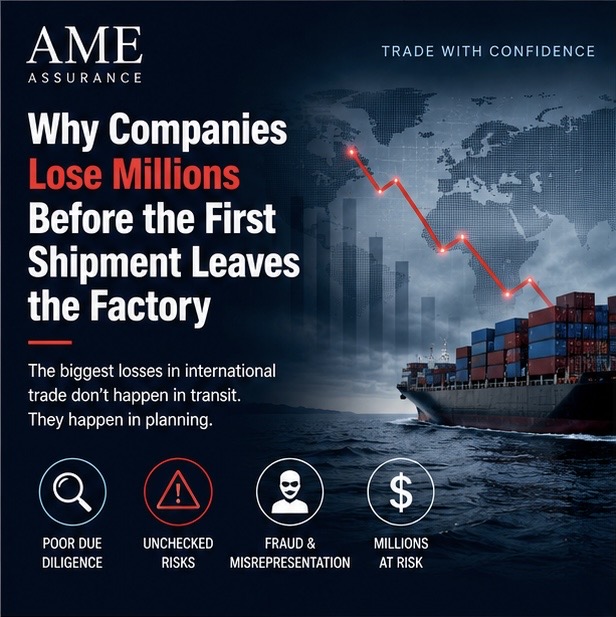
Why Companies Lose Millions Before the First Shipment Leaves the Factory
International trade has never offered greater opportunity. Businesses can source products from almost any country, establish global supply chains, and reach customers across multiple continents. Yet the same environment has also created new risks that many organizations underestimate.
When executives think about international trade risk, they often focus on damaged cargo, delayed shipments, customs inspections, or payment defaults. These risks are real, but they are rarely the reason companies suffer their largest losses.
The greatest losses usually occur long before goods are manufactured or loaded onto a vessel.
Most international trade failures begin with poor decisions made during the planning stage.
A supplier is selected without independent verification.
A distributor is appointed based on personal recommendations.
Bank account changes are accepted through email without additional confirmation.
Contracts are signed before understanding the ownership structure of the counterparty.
Factories are assumed to have production capacity without independent assessment.
Each of these decisions appears reasonable when viewed individually. Together, they create significant commercial exposure.
One of the biggest misconceptions in international trade is that having lawyers, banks, freight forwarders, and insurance companies automatically creates a secure transaction.
It does not.
Each professional performs a specific role. Lawyers review contracts. Banks process payments. Logistics companies move cargo. Inspection companies assess products.
None of them independently evaluate whether the overall transaction should proceed.
This creates a gap between commercial confidence and commercial reality.
Organizations that consistently succeed in international trade treat verification as a strategic discipline rather than an administrative task.
They ask difficult questions before committing capital.
Who ultimately owns the supplier?
Does the factory have sufficient production capacity?
Has the payment instruction changed?
Are there geopolitical or regulatory developments that could affect delivery?
Are commercial assumptions supported by evidence?
The cost of answering these questions is insignificant compared with the cost of recovering from a failed transaction.
The most successful international companies are not those willing to accept greater risk.
They are those that reduce uncertainty before making important decisions.
International trade will always involve risk.
The objective is not to eliminate risk.
The objective is to understand it before it becomes expensive.