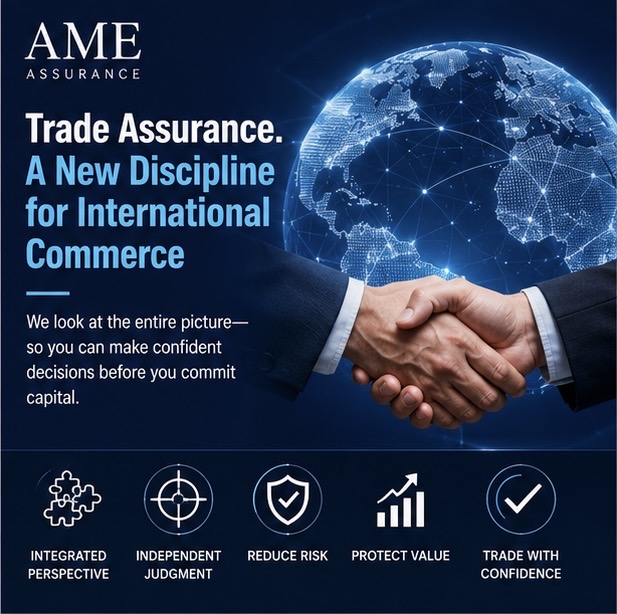
Trade Assurance. A New Discipline for International Commerce
International trade has evolved dramatically over the past several decades.
Supply chains span multiple countries.
Transactions involve numerous financial institutions.
Regulatory requirements continue to increase.
Technology has improved efficiency while simultaneously creating new opportunities for fraud.
Despite these changes, the structure of international transactions has remained largely unchanged.
Lawyers review legal documents.
Banks process payments.
Freight forwarders coordinate logistics.
Inspection companies examine products.
Insurance companies transfer financial risk.
Each plays an essential role.
Yet one important question often remains unanswered.
Who independently evaluates the transaction as a whole?
Trade Assurance addresses this question.
Rather than focusing on one component of a transaction, Trade Assurance examines how all critical elements interact.
It considers counterparties, ownership, operational capability, payment security, documentation, commercial structure, regulatory exposure, and execution risk as parts of one strategic decision.
This approach provides senior management with an integrated assessment before capital is committed.
Trade Assurance is not a replacement for existing professional services.
It complements them.
Its purpose is to bridge the gaps that naturally exist between specialized disciplines.
As international trade becomes more complex, organizations need more than isolated reviews.
They need independent judgment supported by structured analysis.
The companies that consistently succeed in international commerce are rarely the ones willing to accept greater uncertainty.
They are the ones that make better decisions because they invest in understanding risk before it becomes loss.
Trade Assurance represents an important step in that direction.